Dear all,
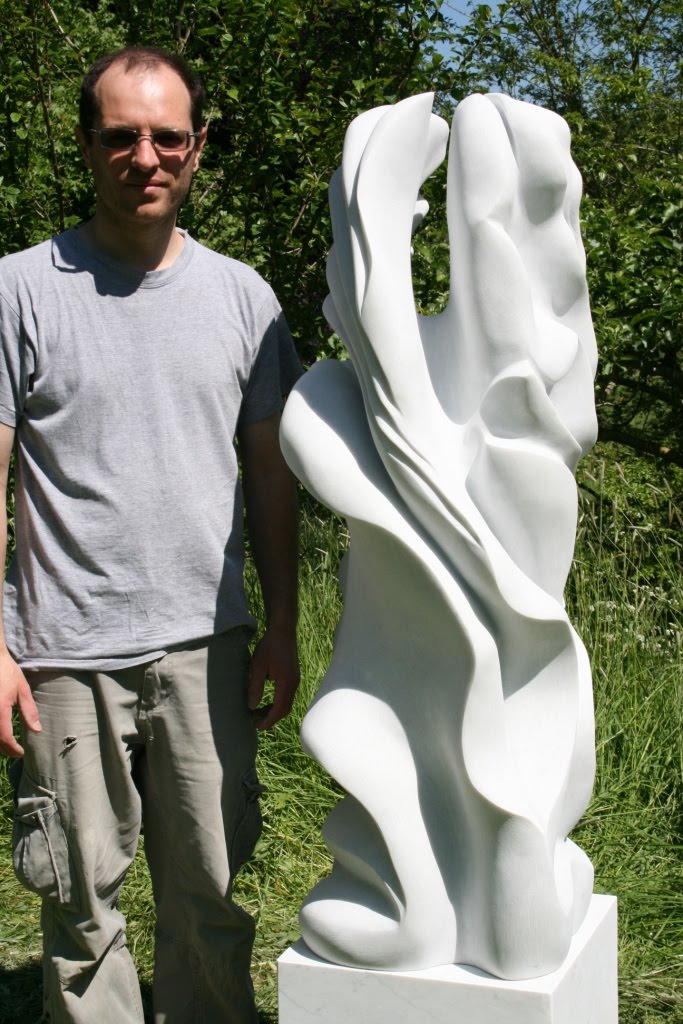
6N0. of my sculptures are on display in a collective open exhibition at the Royal Birmingham Society of Artists RBSA until Christmas.
For more information, please visit the following website: www.rbsa.org.uk
You will see 2No. of my latest works alongside 2No. birds and other abstract sculptures.
Have a good show.
Frederic
Monday, 30 November 2009

Wednesday, 4 November 2009
New video on You tube
Hi everyone,
Here is the link to see my second video, it is about carving a Caen limestone stone which becomes a sail.

The link is the following:
Enjoy...
Frederic
Thursday, 15 October 2009
Carving film on Youtube
Hello everyone,
Here is the link for my first film on Youtube. It is about a block of alabaster becoming a sculpture in 100 seconds. I hope you'll enjoy it.
http://www.youtube.com/watch?v=5ToAksERZ_U
Take care
Frederic
Here is the link for my first film on Youtube. It is about a block of alabaster becoming a sculpture in 100 seconds. I hope you'll enjoy it.
http://www.youtube.com/watch?v=5ToAksERZ_U
Take care
Frederic
Friday, 9 October 2009
New sculpture: a sail in limestone
I am in the process of finishing my first commission: a sail in a beautiful limestone from Caen (Normandy, France). I have already spent around 12hours and should finish after another 3-5hours to work on the details.

The photo shows some very congested areas (the waves are too many, the lines of the sail, in the lower part are far too exagerated). I have already reduced them significantly. After a bit of thinking and work the whole lot should be more acceptable and more homogen.
The film to be broadcasted on Youtube, is going very well. The last set of pictures/film will be produced once the sculpture is completley finished and ready to be at exhibition level.
Frederic
Tuesday, 6 October 2009
Website update
Good news everyone,
My website has been updated: there is a technical section which could be useful to sculptors. This is a large section which lacks photos for the moment but it is still under construction but the text is already user-friendly
For more info, please go to my webpage www.frederic-chevarin.com at the bottom left of the Home page, you will see the "tutorial" title.
If you click on each chapter, the full body of the text will appear to the viewer.
Have a good time, and don't hesistate to tell me if I have been incorrect or completely wrong.
Frederic
My website has been updated: there is a technical section which could be useful to sculptors. This is a large section which lacks photos for the moment but it is still under construction but the text is already user-friendly
For more info, please go to my webpage www.frederic-chevarin.com at the bottom left of the Home page, you will see the "tutorial" title.
If you click on each chapter, the full body of the text will appear to the viewer.
Have a good time, and don't hesistate to tell me if I have been incorrect or completely wrong.
Frederic
Wednesday, 30 September 2009
Hello,
First of all, welcome to the followers of that blog, especially to my first follower: sculptinglady. Thanks a lot, it's fantastic to feel a bit less lonely.
Good news, there will be a lot happening these days on this blog. First of all, I have finished my new piece in alabaster, here is the first published pictures of it.


It took me a while to do it but it is worth it I think. Every face is different so that even two pictures don't give a true ideal of it.
I have also started a new piece; a sail in limestone. While carving, I am making a film so that I will be able to upload a film on stone carving on Youtube.
I hope it could be inspirational to someone.
See you.
Frederic
Thursday, 27 August 2009
Choosing stones
The most important is to get a sound stone. It means the stone should be free of cracks and unsound areas. To test the stone, take a hammer and hit the piece so that it can ring. If it sounds like steel (“ring, ring”) with a clear sound, your stone is good. If the sound is a “toc toc” or “cloc”, the stone can’t resonate well because of a crack. You should either leave the piece and test another one or try to investigate to see where is the crack. Its location it important. If the crack is at the edge, it will have to come off sooner than later. If it is right in the middle, you’ll have to divide the stone in 2No. pieces. If you don’t separate them, glue them. I don’t like this option as it might be a waste of time working on a bad stone which could result in a broken sculpture later anyway.
It is important to know that some stones don’t sound at all. Some alabaster pieces might sound ok but can be cracked because of the nature of the piece. Experience is the only way to know how dangerous a crack is. But usually, an open crack means it is a dodgy stone, if it is a closed crack (not through the stone) it can be ok.
After the hammer test, a close look at every sides of the stone should be done. Search for cracks, discolouring and staining (especially oil contents which penetrate the stone permanently. They can’t be cleaned by a chemical agent. Remove the stained material until a clean stone is emerging). Use water to pour onto larger blocks. If the water gets in the stone and shows a zone which is getting dryer than the rest, there is a crack. In any case, the stone should be clean (meaning free of dirt) for close inspection.
It is important to know that some stones don’t sound at all. Some alabaster pieces might sound ok but can be cracked because of the nature of the piece. Experience is the only way to know how dangerous a crack is. But usually, an open crack means it is a dodgy stone, if it is a closed crack (not through the stone) it can be ok.
After the hammer test, a close look at every sides of the stone should be done. Search for cracks, discolouring and staining (especially oil contents which penetrate the stone permanently. They can’t be cleaned by a chemical agent. Remove the stained material until a clean stone is emerging). Use water to pour onto larger blocks. If the water gets in the stone and shows a zone which is getting dryer than the rest, there is a crack. In any case, the stone should be clean (meaning free of dirt) for close inspection.
Subscribe to:
Posts (Atom)